The tragedy of parental alienation

Ceara Deno, MD • July 28, 2021
Schedule A Free Call

Is this happening to you?  Someone you know?
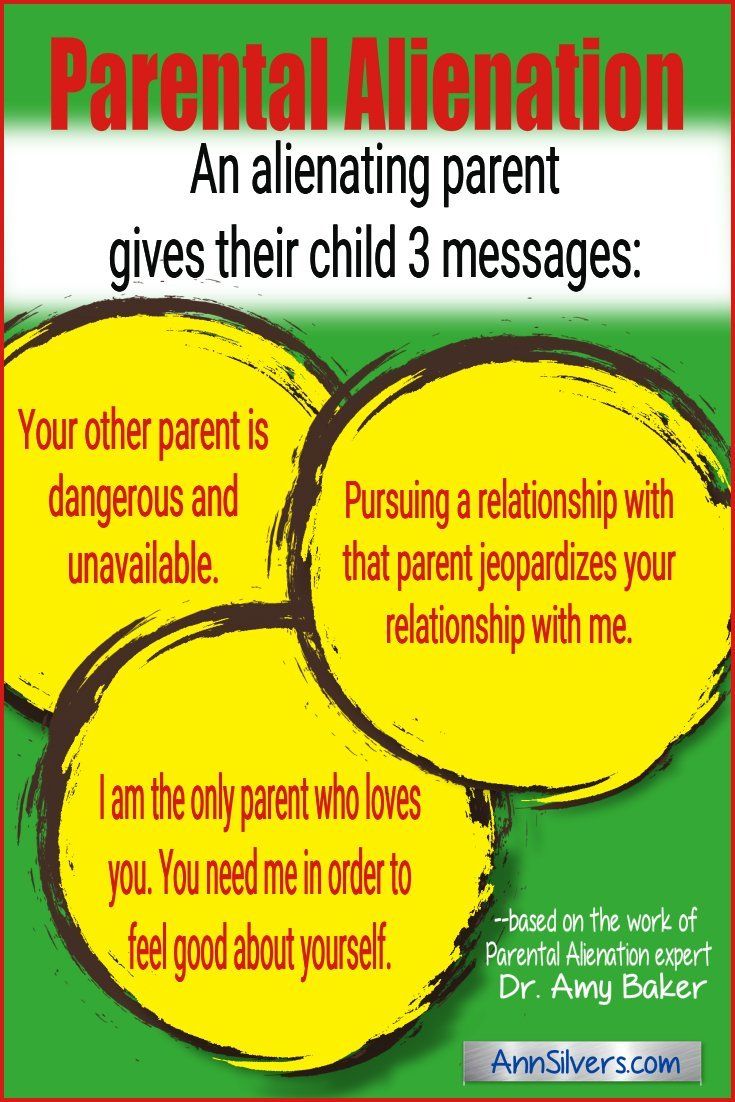
“Your father is dangerous, you can't trust him”

“Your mother is selfish, she only cares about herself” 


Parental alienation is a heartbreaking truth of some divorces. 


Parental alienation is when one parent actively poisons parent-child relationship with the other parent to punishment their ex-spouse. 


The child, who becomes a caretaker for the more vulnerable parent’s feelings, sides with the alienating parent, to keep the peace and to avoid upseting the more vulnerable parent.


The alienating process may start years before the divorce, when one parent actively creates emotional dependence on the children—relying on the child as emotional support—while actively turning the children away from the other parent.


How does this happen?  It happens by:


—Badmouthing the other parent (“that’s all your father got your for your birthday?  He’s so cheap”; “your mother is so crazy, she should be in a hospital”)


—Intentionally sharing adult information that is not appropriate for children (“your mother is a drunk;” “your father cheated on me our whole marriage”)


—Withholding parenting time, preventing phone calls, or withholding information from the other parent


 All children deserve to have an open, loving relationship with both parents—regardless of how contentious the divorce—regardless of how bad the relationship between the adults. 


Is parental alienation happening to you, or someone you know?  Does this sound familiar?  If this is happening to you, it can be heartbreaking.  I know.


I can help.  I work with divorced parents to reconnect with their children based on openness, trust, security and safety.  I help parents reconnect when the relationship has been damaged.  It isn’t easy, but it’s worth it. 


I’ve been divorced, and I know how challenging these issues can be.  But there is hope.


By Ceara Deno, MD January 27, 2026
Discover why real change with sensitive, strong-willed kids starts in the parent—not the child. Learn how steadiness, not control, breaks power struggles and helps your child thrive.
By Ceara Deno January 20, 2026
Struggling to stay calm with your sensitive child? Learn why regulation often looks boring, why doing less is more effective, and how slowing down transforms your parenting and your child’s nervous system.
By Ceara Deno, MD January 14, 2026
When your child melts down over small mistakes or corrections, it’s not defiance—it’s nervous system overwhelm. Learn what helps sensitive kids feel safe and build confidence.
By Ceara Deno, MD January 5, 2026
Some kids strongly resist being told what to do—not because they’re defiant, but because loss of control feels unsafe. Learn why this happens and what actually helps.
By Ceara Deno, MD December 18, 2025
Overstimulated this December? Learn gentle, practical ways sensitive families can reduce holiday overwhelm, support emotional regulation, and create calmer connections during the holidays.
By Ceara Deno, MD December 8, 2025
Learn the common signs of an empath child and how to understand their deeply sensitive, emotionally attuned nature. A clear guide for parents and caregivers.
By Ceara Deno, MD December 1, 2025
Learn simple, connection-based corrections that help highly sensitive kids feel understood, supported, and more confident with big emotions.
By Ceara Deno, MD November 19, 2025
Discover why children labeled as “too sensitive” or “difficult” often grow into resilient, compassionate, and determined adults. Learn how your big-feeling child’s challenges today can become their greatest strengths tomorrow.
By Ceara Deno, MD November 10, 2025
Feeling disconnected from your child doesn’t mean you’ve lost them. Learn why disconnection is often a sign of overwhelm—especially for highly sensitive kids—and how to rebuild connection with calm, curiosity, and compassion.
By Ceara Deno, MD October 27, 2025
Discover why lectures don’t build frustration tolerance in kids—and what actually does. Learn how calm, humor, and modeling teach emotional resilience.
More Posts